
An Seanfhocal na Seachtaine - Proverb of the Week
A featured proverb with its meaning, origin and a little story behind it.
Seanfhocal na Seachtaine - Proverb of the Week #1
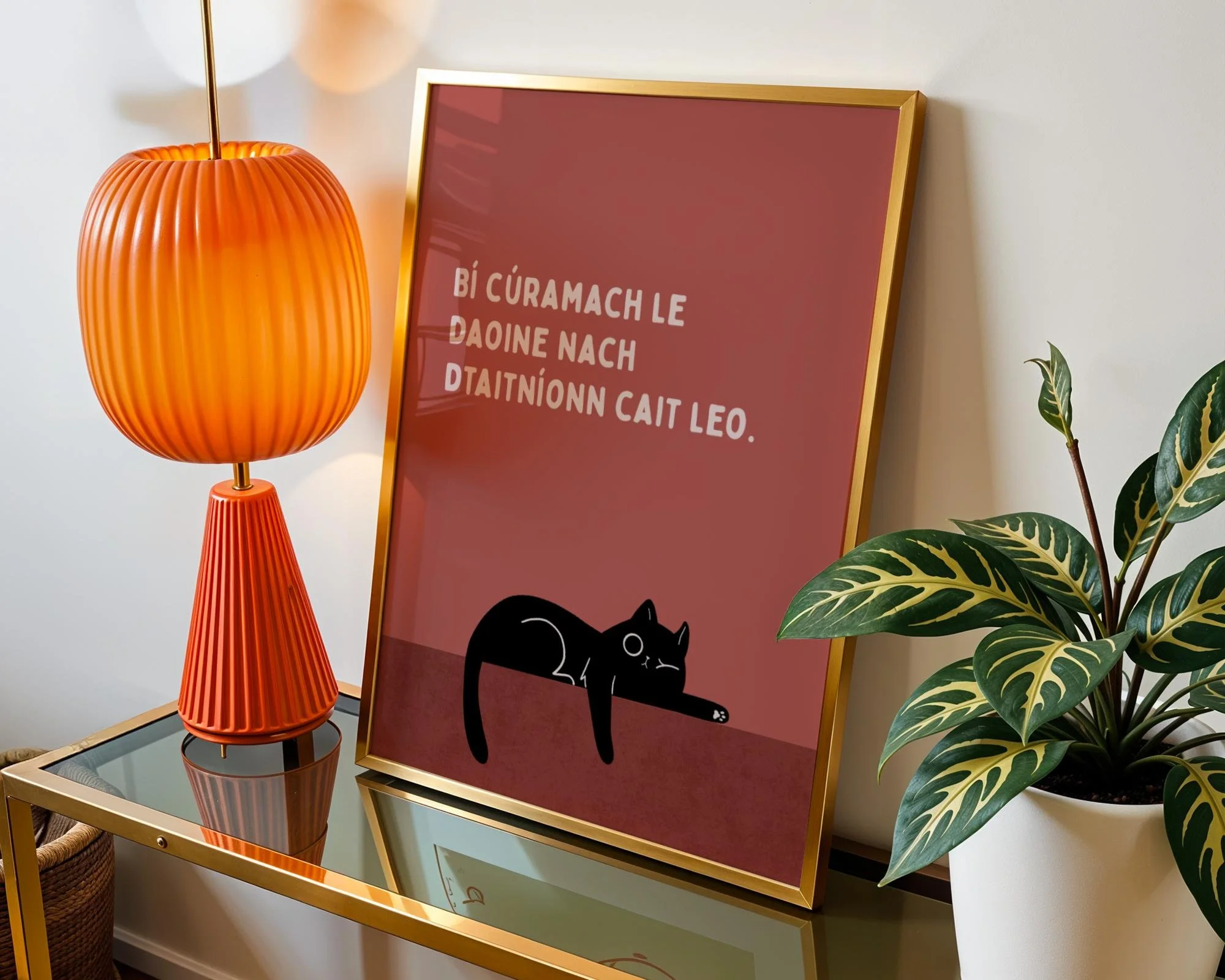
Bí cúramach le daoine nach dtaitníonn cait leo
"Be careful of people who don't like cats"
Where else would I start?
I'm a certified cat lady, proud mamó to three semi-wild cats with Game of Thrones names, so this seanfhocal has a very special place in my heart. If you follow us on Instagram you may have already met them. They judge everyone ferociously and I respect that enormously.
Breaking it down - Focal ar fhocal (Word by word)
Irish English
Bí Be
cúramach careful
le with/of
daoine people
nach dtaitníonn who don't please/who don't like
cait cats
leo them/with them
A little note on dtaitníonn. Irish expresses "liking" differently to English. Rather than saying "I like cats", Irish says "taitníonn cait liom" , literally "cats please me." Isn't that a lovelier way to put it? The thing you love does the action, not you.
The grammar bit (don't worry, we'll keep it friendly!)
Nach dtaitníonn is a negative relative clause, it's the Irish way of saying "who don't." The nach triggers what's called an urú (eclipsis) on the verb so taitníonn becomes dtaitníonn. You'll see this pattern a lot in Irish and once you spot it, you can't unsee it!
An duine a thaitníonn cait leo — the person who likes cats
An duine nach dtaitníonn cait leo — the person who doesn't like cats
A bit of history
The Irish have always had a knowing relationship with cats. In early Irish mythology, cats were associated with the otherworld. Mysterious, independent, and not entirely to be trusted. There's a famous cave in County Roscommon called Carn Froích said to be guarded by a monstrous cat. Even in folklore, cats were seen as creatures who knew things humans didn't.
This proverb reflects something deeply Irish. The belief that how a person treats an animal tells you everything you need to know about their character. It's quiet wisdom, wrapped in a simple sentence, the way the best seanfhocail always are.
Using it in everyday life
You could drop this into conversation when a new person comes to visit. Let the cat decide first. If the cat approves, you're grand. If not... bí cúramach.
Try saying it out loud: "Bí cúramach le daoine nach dtaitníonn cait leo" Pronounced roughly: Bee koor-a-mach le dee-na nac dat-in-yun cat lyo
Want this on your wall?
Our Bí Cúramach cat print is one of our most loved designs — and honestly, it doubles as a very polite way to warn houseguests. Available in the shop in multiple sizes.
Ar thaitin sé sin leat? Did you enjoy that? Let us know in the comments or come find us on Instagram @croi_co — we'd love to hear which seanfhocal you'd like us to cover next!
Seanfhocal na Seachtaine - Proverb of the Week #2
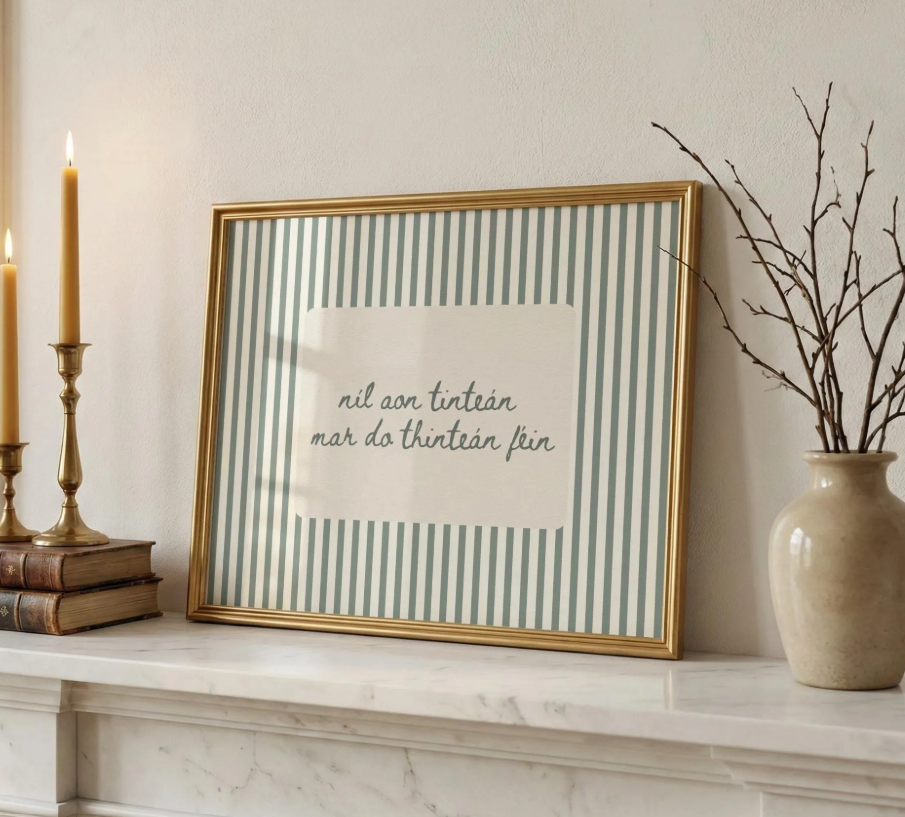
Níl aon tinteán mar do thinteán féin
"There's no place like home"
I couldn't not write about this one. Obvious selection I know!
Níl aon tinteán mar do thinteán féin is our best selling print, and when I think about who buys it, it makes complete sense. It's the Irish person living abroad who hangs it ion their wall and feels a little closer to home. It's the mammy whose child has just emigrated who sends it as a care package. It's the Irish-American who has never set foot in Ireland but feels that pull in their bones.
This seanfhocal travels. Because the feeling it describes travels with every Irish person who has ever left.
You've heard it in English a thousand times. But did you know the Irish said it first?
Níl aon tinteán mar do thinteán féin, there is no hearth like your own hearth. And honestly, the Irish version is better. Because it's not just about home in the abstract, it's about the tinteán. The hearth. The fire. The warm centre of the house where the family gathered, where the stories were told, where the kettle was always on.
That's not just a saying. That's a whole philosophy of life.
Breaking it down — Focal ar fhocal (Word by word)
Irish English
Níl There is not
aon any
tinteán hearth / fireplace
mar like / as
do your
thinteán hearth (lenited form)
féin own / self
A little note on thinteán, notice how tinteán becomes thinteán after do (your)? This is called a séimhiú (a softening) one of Irish grammar's most distinctive features. When certain words follow certain other words, the first letter gets softened with an h. So tinteán (tin-TAWN) becomes thinteán (hin-TAWN). Once you start hearing it, you'll notice it everywhere in Irish.
The grammar bit (don't worry, we'll keep it friendly!)
Níl is the negative form of tá, the Irish verb "to be." Irish has two separate verbs for "to be" — tá for states and conditions, and is for identity and classification. This trips up every Irish learner at some point!
Tá tinteán agam — I have a hearth (literally "a hearth is at me")
Níl tinteán agam — I don't have a hearth
Níl aon tinteán mar do thinteán féin — there is no hearth like your own hearth
Also notice féin, this word means "self" or "own" and you'll hear it constantly in Irish conversation. Mé féin (myself), tú féin (yourself), é féin (himself). It adds real emphasis, not just your hearth, but your very OWN hearth.
A bit of history
The hearth was the heart of the Irish home for centuries. Before central heating, before electricity, before radiators, the fire was everything. It provided warmth, light, a means to cook, a place to gather. In early Irish law, the hearth was so central to the concept of home that it featured in legal definitions of a household.
In Irish mythology, Brigid, goddess of fire, poetry and healing, was associated with the sacred flame. When Christianity arrived, she became Saint Brigid, and the tradition of the sacred flame continued at Kildare for centuries.
To keep the fire alive was to keep the home alive. Families would smoor the fire at night, carefully banking the embers to keep them going until morning, rather than let it go out completely. Letting the fire die was almost an omen.
So when the Irish say níl aon tinteán mar do thinteán féin, they're not just saying home is nice. They're saying the hearth, your hearth, your fire, your centre, is irreplaceable.
Using it in everyday life
This one is perfect for when you arrive home after a holiday, a long day, a difficult week. Step through the door, put the kettle on and say it out loud:
"Níl aon tinteán mar do thinteán féin."
Try saying it: Neel ayn tin-TAWN mar duh hin-TAWN fayn
You can also use it when someone asks why you didn't stay longer somewhere. "Ah sure, níl aon tinteán mar do thinteán féin" , says everything that needs to be said, with considerably more poetry than "I missed my bed."
Want this on your wall?
Our Níl Aon Tinteán print is one of our most beloved designs because there truly is no place like home, and now you can have that reminder in Irish every single day.
https://www.etsy.com/ie/listing/4481382381/irish-print-o-nil-an-tintean-mar-do
Ar thaitin sé sin leat? Did you enjoy that? Let us know in the comments or come find us on Instagram @croi_co — we'd love to hear your memories of home. And if you'd love a little piece of the Irish language on your wall every day, you know where to find us!
Seanfhocal na Seachtaine - Proverb of the Week #3
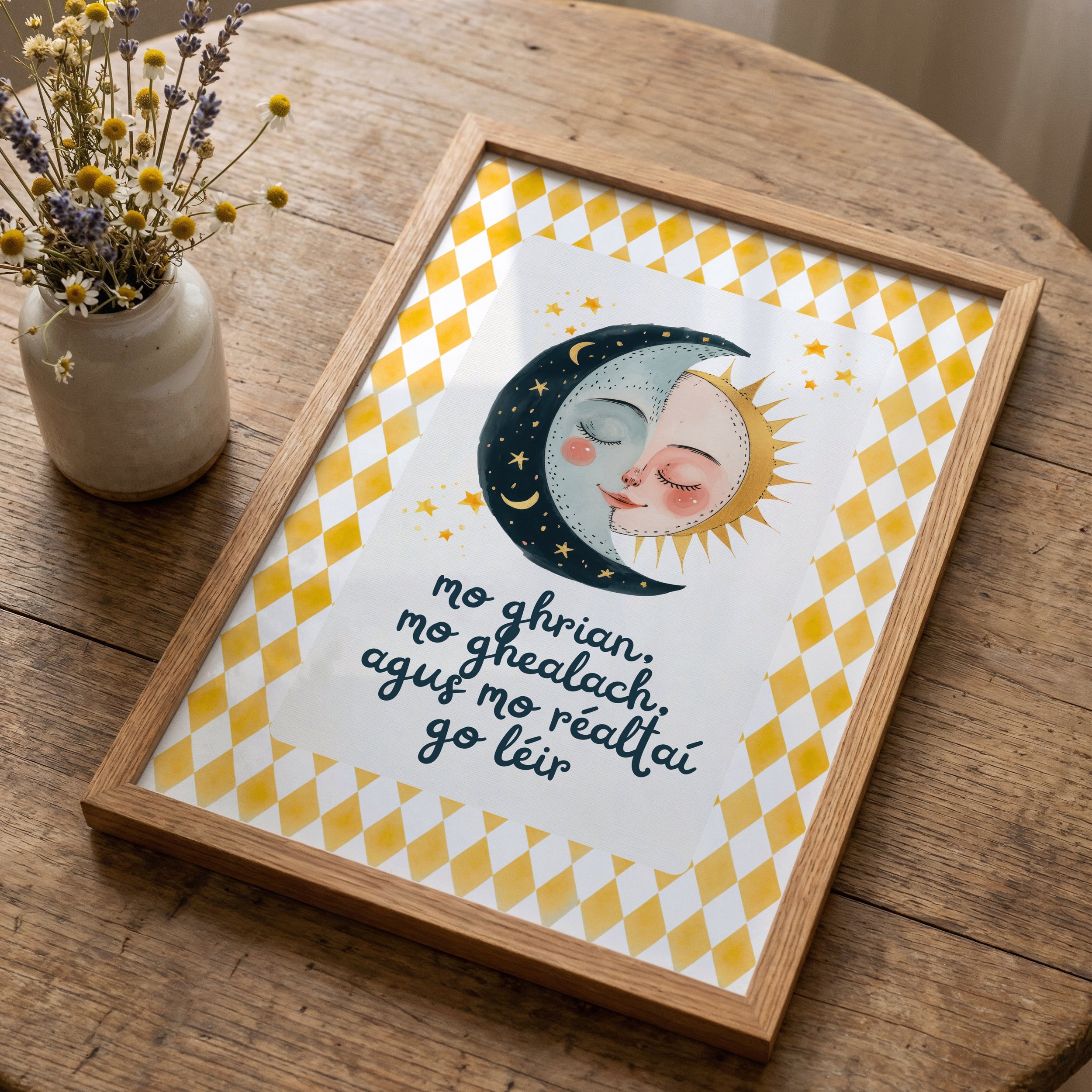
An Seanfhocal na Seachtaine - Mol an Óige agus tiocfaidh sí
Praise the youth and they will flourish.
This week's seanfhocal is one of the most well-known in the Irish language — and honestly, one of my favourites. Partly because it's beautiful. Mostly because I have two small boys and I need all the parenting advice I can get.
Breaking it down:
Mol — praise
an óige — the youth
agus — and
tiocfaidh sí — it/she will come (it will flourish)
Simple words. Big meaning.
What does it actually mean?
The idea is that encouragement is everything when it comes to children. You don't push youth into who you want them to be — you praise them, nurture them, and let them grow into themselves. The Irish knew this long before any parenting book told us.
There's something quietly radical about it too. In a culture that could be hard and unforgiving, this proverb is gentle. It says: be kind to the young ones. It matters.
Why it resonates with me
Part of the reason I moved back west was to give my boys a slower, more rooted childhood. To bring Irish back into our home not as something they had to learn, but as something that was just... there. Part of the furniture.
This seanfhocal sits at the heart of that. If I keep using the language around them, keep making it warm and fun and normal, maybe it'll stick. Maybe they'll tiocfaidh sí.
We'll see. 😄
Want this on your wall?
Browse the Croí & Co. Irish language print collection — designed in Ireland, for Irish homes. 💚
Gaeilge sa Bhaile -
Irish at Home
Short, friendly tips like greetings, phrases for kids, things to say at the dinner table etc.
Gaeilge sa Bhaile - Irish at Home #2
You're More Irish Than You Think
The words and phrases that give us away every time!
Have you ever been abroad, chatting away, and suddenly the person across from you gets a look of pure confusion on their face.
"Sorry, you were giving out because the young fella was doing what?"
And that's when it hits you. What you thought was perfectly normal English is, in fact, entirely and uniquely Irish. Welcome to Hiberno-English, the wonderfully expressive way that the Irish language shaped the English we speak every day, whether we realise it or not.
Words you're using that actually come from Irish
These words have travelled so far from their roots that even English dictionaries have claimed them, but make no mistake, they're ours!
Word Where it comes from What it means
Smithereens Smidiríní Tiny little fragments
Galore Go leor Enough, plenty
Slew Slua A crowd, a large number
Brogue Bróg (shoe) An Irish accent
Tory Tóraidhe Pursuer, outlaw
Go leor is the one that gets people every time. The next time someone says "craic galore", they're speaking Irish and they don't even know it.
And tóraidhe , outlaw, pursuer — becoming the name of a British political party is, frankly, the most Irish thing that has ever happened.
Hiberno-English — the words we thought everyone used
These aren't slang. They're not lazy English. They're a living record of a language that refused to disappear even when its speakers were forced to stop using it. The structure, the logic, the worldview of Irish is right there underneath every one of these words.
Giving out — complaining or scolding "She was giving out about the weather." Perfectly normal sentence in Ireland. Absolutely baffling everywhere else.
Bold — naughty, especially for children "You've been very bold." Elsewhere bold means brave or daring. In Ireland it means your mammy is not one bit impressed with you.
Grand — fine, okay, acceptable "Sure it'll be grand." The most Irish sentence ever spoken. Contains within it an entire philosophy of life — a gentle acceptance that things are neither brilliant nor terrible, and that's absolutely fine.
Press — a cupboard "The cups are in the press." Said by every Irish mammy since time began. Causes chaos in IKEA.
Messages — groceries or shopping "I'm going into town for the messages." Nobody knows exactly why. Nobody questions it.
Yoke — thing, object, gadget, person, concept, anything at all "Pass me that yoke there." The most versatile word in the Irish language. Can refer to literally anything. A remote control. A mystery vegetable. Your cousin's new boyfriend. A complicated feeling.
Jacks — the toilet "Where's the jacks?" Likely from the name Jack — as in Jack Jones, Cockney rhyming slang for bones, or possibly just a name associated with outdoor privies. Either way, entirely ours now.
Deadly — excellent, brilliant "That's a deadly idea." Causes genuine alarm in other countries. Here it is the highest praise.
Gas — funny, amusing "He's gas altogether.""Altogether" doing a lot of work in that sentence as well, now that we think about it.
Cat — awful, terrible (especially in Munster) "That match was cat." Nothing to do with actual cats. Unless the cat in question has just knocked your good mug off the counter, in which case it is also very much cat.
Phrases that are direct translations from Irish
This is where it gets really interesting. These phrases sound like perfectly normal English to Irish ears — because they are perfectly normal Irish, just wearing an English costume.
"I'm after doing it" Meaning: I've just done it. From the Irish construction tar éis — after. Tá mé tar éis é a dhéanamh. The Irish sense of time bleeding straight through into English.
"He does be working late" The legendary do be — used to describe something that happens habitually, regularly, as a pattern. Irish has a whole separate verb form for this. English doesn't, so we improvised.
"Sure look" Possibly the most untranslatable Irish phrase in existence. It can mean: I accept this situation. I have moved on from this situation. I don't want to talk about this anymore. It is what it is. Let's change the subject. All of the above simultaneously.
"Is it?" Used as a response to new information. "I'm moving house.""Is it?" Not a question. Not disbelief. Just acknowledgement with a slight air of interest. Magnificent.
"The fear of God is on me" Meaning: I am extremely worried or terrified. Direct translation of tá eagla Dé orm. Dramatic, poetic, and very relatable.
Words Irish people don't realise are Irish-only
A special mention for this category — the words that feel so normal, so everyday, that it comes as a genuine shock to discover the rest of the world has no idea what you're on about.
Eejit. Langer. Gowl. Manky. Scuttered. Acting the maggot. Shift. Culchie. Gaff.
Every single one of these has caused an Irish person abroad to stop mid-sentence, watch the confusion spread across a foreign face, and experience a small but profound identity crisis.
"Wait — you don't say gaff for house?""You've never heard of acting the maggot?""How do you not know what scuttered means?"
And in that moment, without even meaning to, you realise just how deeply Irish you are — right down to the words you didn't even know were yours.
Seanfhocal to finish:"Is fearr Gaeilge bhriste ná Béarla cliste." Broken Irish is better than clever English.
Keep going. Every word counts.
Did any of these surprise you? Come tell us on Instagram @croi_co — we'd especially love to know the one that gave you away abroad! And if you want a little piece of the Irish language on your wall every day, you know where to find us.
Gaeilge sa Bhaile - Irish at Home #3
Tús Áite - First Things First
The everyday Irish phrases everyone can learn
Every language journey starts somewhere. And the best place to start is always the same — the words you use every single day without even thinking about them.
Hello. Goodbye. Thank you. How are you?
These are the building blocks. The ones that, once you know them, make you feel like a little piece of the language belongs to you. And in Irish, even these simple everyday phrases have a beauty and a depth to them that English just can't match.
So let's start at the very beginning. Tús maith, leath na hoibre, a good start is half the work!
Beannachtaí — Greetings
Let's start with hello. Now, Irish doesn't actually have a direct word for hello — which feels very Irish altogether. Instead, you greet someone by calling God to them. Literally.
Irish Pronunciation English
Dia duit Dee-a gwit Hello (literally "God to you")
Dia is Muire duit Dee-a iss Mwira gwit Hello back (literally "God and Mary to you")
Haigh! Hah-ig Hi! (the casual version)
Cad é mar atá tú? Kah-jay mar ah-taw too How are you?
Conas atá tú? Kun-us ah-taw too How are you? (Munster Irish)
Cén chaoi a bhfuil tú? Kay khwee will too How are you? (Connacht Irish)
Tá mé go maith Taw may guh mah I'm well
Go hiontach! Guh HUN-tach Wonderful! / Great!
Tá mé ceart go leor Taw may kyart guh lore I'm fine / okay
Tá mé tuirseach Taw may tir-shach I'm tired
Tá mé gnóthach Taw may GNOH-hach I'm busy
A little note on Dia duit . This is one of those beautiful moments where Irish reveals its soul. You don't just say "hi", you call God's blessing on the person you're greeting. And they call God AND Mary back to you. Even if you're not religious, there's something extraordinarily warm about a language where every hello is also a blessing.
And Haigh , yes, that's the Irish for the casual "hi!" Pronounced just like the English, spelled the Irish way. Simple, friendly and very much in use among young Irish speakers today.
Buíochas — Thanks
Irish Pronunciation English
Go raibh maith agat Guh rev mah agut Thank you (to one person)
Go raibh maith agaibh Guh rev mah AH-giv Thank you (to a group)
Go raibh míle maith agat Guh rev MEE-la mah agut Thank you very much (literally "a thousand thanks")
Tá fáilte romhat Taw FALL-cha ROH-ut You're welcome
Ná habair é Naw HAB-ir ay Don't mention it
Go raibh míle maith agat, a thousand thanks. Because in Irish, one thank you is never quite enough!
Slán — Goodbyes
Irish has several ways to say goodbye depending on who is staying and who is leaving, which is very specific and very Irish!
Irish Pronunciation English
Slán Slawn Goodbye / Safe (general)
Slán agat Slawn AH-gut Goodbye (said by person leaving)
Slán leat Slawn lat Goodbye (said to person leaving)
Slán abhaile Slawn ah-WALL-eh Safe home
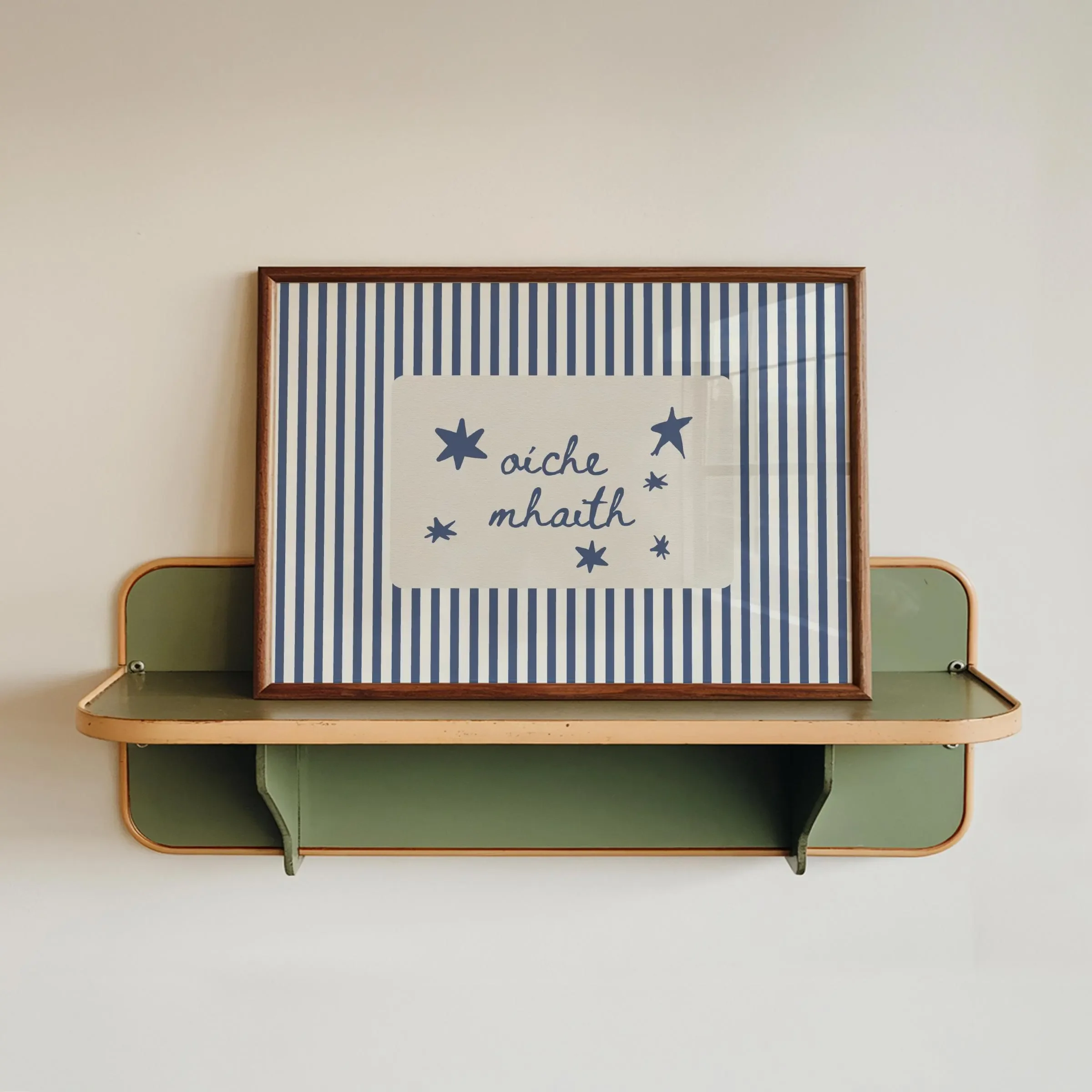
Oíche mhaith EE-ha wah Good night
Codladh sámh CUL-ah sawv Sleep well / Sweet dreams
Feicfidh mé thú FEK-ee may hoo I'll see you
Go n-éirí an bóthar leat Guh NYE-ree on BOH-her lat May the road rise with you
Slán abhaile is a lovely one. You say it to someone as they leave meaning safe home. Two words that contain an entire wish for someone's wellbeing on their journey. Every Irish mammy has said these words to every child leaving the house since the beginning of time.
And codladh sámh — peaceful sleep. What a gorgeous thing to say to someone at the end of the day. It's what I say to my cats every night, and they ignore me completely, but that's beside the point.
Focal Eile — Other Useful Phrases
Irish Pronunciation English
Le do thoil Leh duh hull Please
Gabh mo leithscéal Gov muh LEH-shkale Excuse me / Sorry
Tá brón orm Taw brohn orum I'm sorry
Cabhair! COW-ir Help!
Cinnte! KIN-cha Certainly! / Of course!
Ar ndóigh! Er NOH-ee Of course! / Naturally!
Gan dabht Gon dowt Without a doubt
Is dóchaIss DOH-cha Probably / I suppose
B'fhéidir BEH-jir Maybe / Perhaps
Más é do thoil é Maws ay duh hull ay If you please / Please (formal)
Your challenge this week — Do dhúshlán na seachtaine
Pick THREE phrases from this list and use them every day this week.
My suggestions for beginners:
Haigh! when you see someone — easy, friendly, instant Irish
Go raibh maith agat instead of thank you — you probably half know this one already
Slán abhaile when someone leaves — two words that will make any Irish person smile
That's it. Three phrases. Seven days. By next week they'll feel natural — gan dabht!
A little encouragement
You might feel a bit silly at first. You might mispronounce things. Your family might look at you strangely across the dinner table.
Is cuma. — It doesn't matter.
Is fearr Gaeilge bhriste ná Béarla cliste — broken Irish is better than clever English. Every single attempt matters. Every word spoken is a small act of love for a language that deserves to survive.
Tá tú iontach — you're wonderful. Keep going.
Ar thaitin sé sin leat? Did you enjoy that? Come find us on Instagram @croi_co and let us know which phrase you're going to try this week! And if you'd love a beautiful Irish phrase on your wall to inspire you every day — you know where to find us.